



21st October 2026 - Vamos Falar de Livros 14
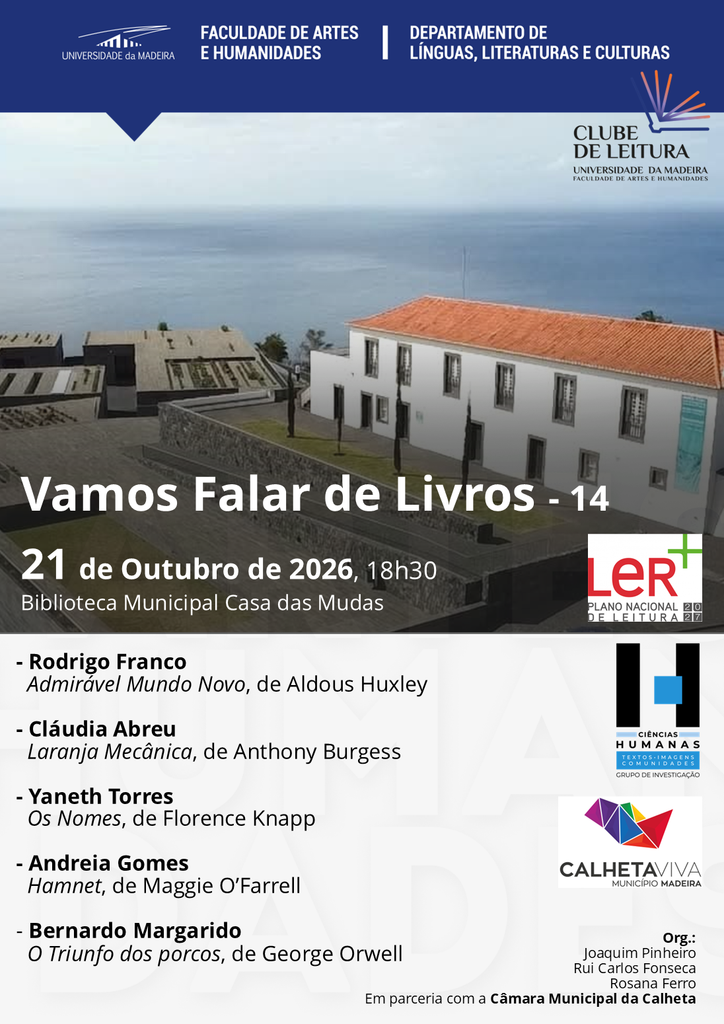
The Faculty of Arts and Humanities at the University of Madeira, through the Department of Languages, Literatures and Cultures, in partnership with Calheta Town Council, will be hosting the 14th edition of ‘Let’s Talk About Books’ on 21 October 2026, starting at 6.30 pm, at the Casa das Mudas Municipal Library.
– Rodrigo Franco
Brave New World by Aldous Huxley
– Cláudia Abreu
A Clockwork Orange by Anthony Burgess
– Yaneth Torres
The Names by Florence Knapp
– Andreia Gomes
Hamnet by Maggie O'Farrell
– Bernardo Margarido
Animal Farm by George Orwell
8th and 9th October - Workshop: AI in the process of learning foreign languages
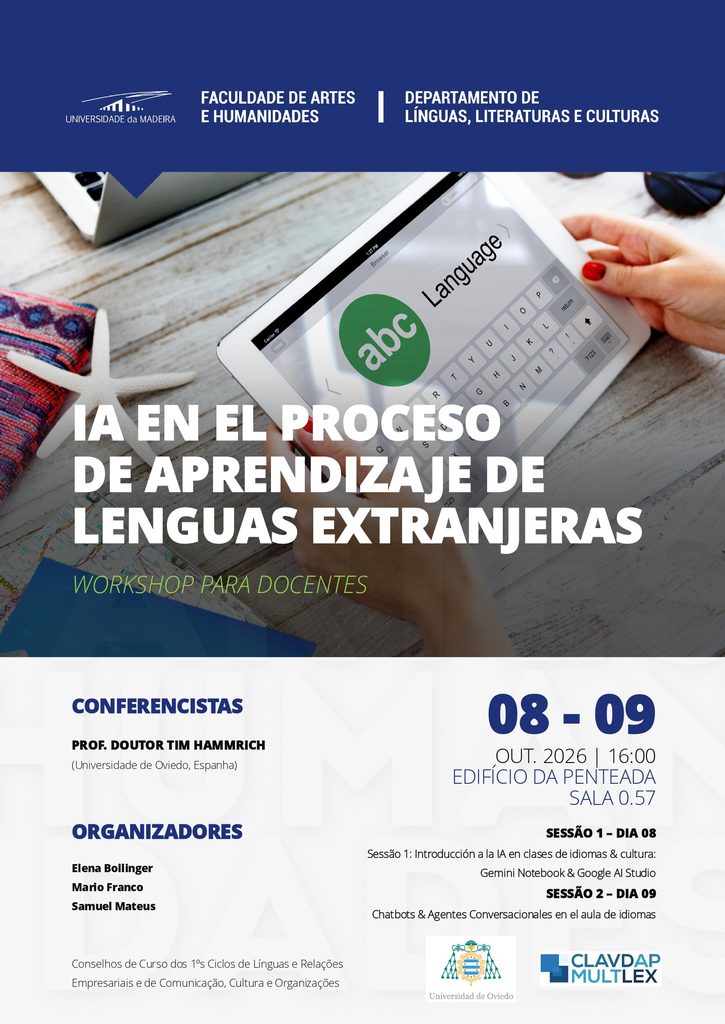
On 8 and 9 October, the workshop AI in the foreign language learning process will take place, organised by the Department of Languages, Literatures and Cultures of the Faculty of Arts and Humanities, through the Course Councils of the Bachelor’s degree programmes in Languages and Business Relations and in Communication, Culture and Organisations.
The workshop consists of two separate sessions:
Session 1: Introduction to AI in language and culture classes: Gemini Notebook & Google AI Studio
8/10/2026 at 4pm
Room 0.57, Ground Floor, Penteada Building, University of Madeira
Session 2: Chatbots & Conversational Agents in the language classroom
9/10/2026 at 4pm
Room 0.57, Ground Floor, Penteada Building, University of Madeira
The workshop is aimed at teachers, university lecturers and others with an interest in education who wish to integrate AI competently and thoughtfully into the teaching of foreign languages.
To ensure participants get the most out of the workshop, we suggest they bring the following items:
• Laptop or tablet, with headphones and a microphone
• Any teaching materials (texts, textbooks, vocabulary lists, images, etc.) used in lessons (in PDF and/or printed form)
• One of your own publications (any one) in PDF format
It is by no means compulsory (the speaker will also provide materials), but it will enable them to work on aspects relating to their own lessons.
Workshop Summary
Artificial Intelligence (AI) is profoundly transforming the way we teach and learn, and this is particularly relevant to foreign language teaching. This workshop offers a well-founded and practical perspective on how to integrate AI in a meaningful and thoughtful way into the language learning process.
To begin with, an introduction to the key concepts of AI will be provided. Among other aspects, the following questions will be addressed: what do we actually mean by (generative) AI? How does it work, in simple terms? How can it contribute to language learning, and what are its limitations? What is AI literacy? Rather than focusing on technical aspects, the aim will be to understand the educational implications of AI, clarify common questions and establish a common ground for critical reflection on the subject.
Selected tools will then be presented and analysed, accompanied by specific examples of good practice. Topics such as writing support, personalised feedback, the development of lexical competence, and the creation of tasks and activities using AI will be covered. Participants will receive practical guidance on how to use AI in a pedagogically effective, transparent and responsible manner.
Another key focus of the workshop will be the analysis of recent publications and relevant scientific findings. What do studies reveal about the effectiveness of AI in the context of language learning? Where do the main benefits lie, and what are the associated risks? These issues will be critically analysed and linked to teaching practice.
Similarly, we will seek to establish links with theories of learning and language acquisition, emphasising that AI is not an end in itself and that it can only be effective when used on the basis of sound didactic principles and a pedagogically grounded approach.
8th October - Learning German using AI (Open lecture)
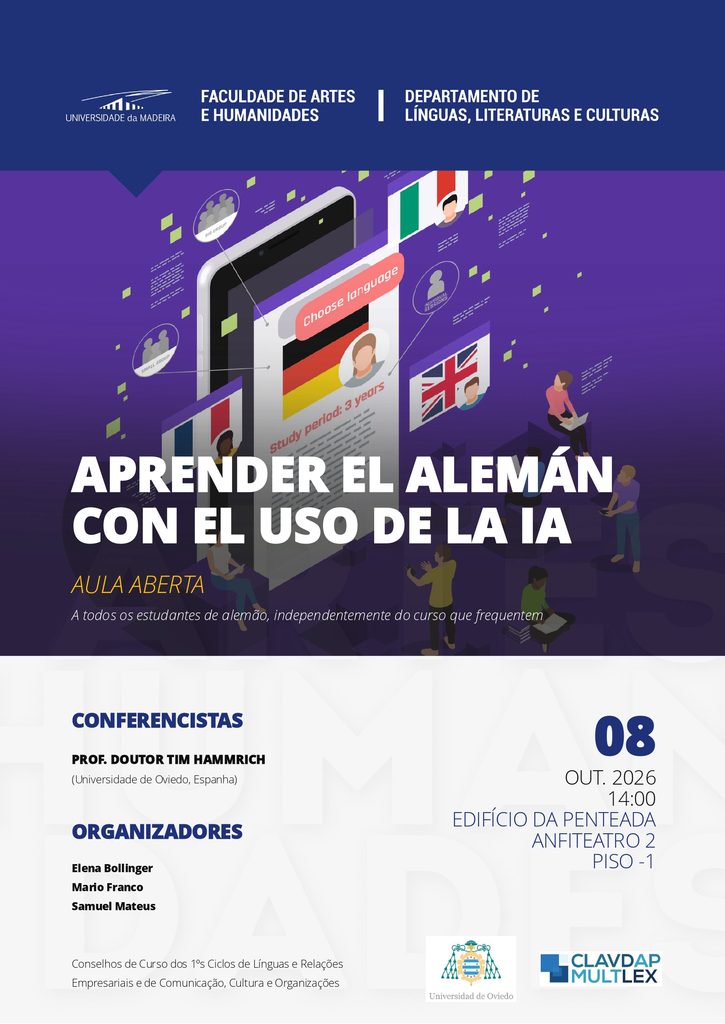
On 8 October, the Open Lecture “Learning German with the use of AI” will take place, organised by the Department of Languages, Literatures and Cultures of the Faculty of Arts and Humanities, through the Programme Councils for the Bachelor’s degrees in Languages and Business Relations and in Communication, Culture and Organisations.
The open lecture will take place from 2.00 pm in Amphitheatre 2, Level -1, of the Penteada Building, and will feature a presentation by Professor Tim Hammrich, PhD, from the University of Oviedo.
This activity is open to all students of German, regardless of the course they are on.
Event postponed, date to be confirmed – Better Lessons, Sharper Judgment: Using AI in Teaching and Research Preparation
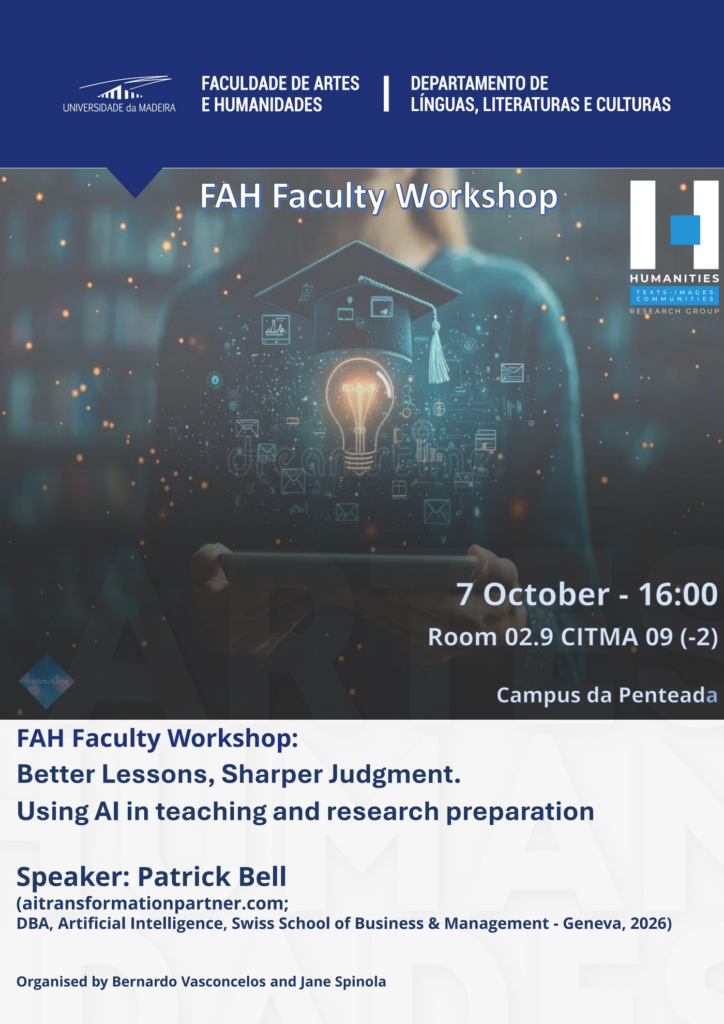
We are pleased to invite all faculty members to “Better Lessons, Sharper Judgment: Using AI in Teaching and Research Preparation,” a workshop led by Patrick Bell, an AI transformation advisor and doctoral researcher with over 25 years of experience advising organisations across industries and continents. Patrick Bell’s work focuses on helping leaders understand why AI initiatives succeed or fail, emphasising strategic clarity, governance, and practical integration without requiring technical expertise. This session will offer faculty actionable insights to strengthen lesson design and exercise sharper judgment when adopting AI tools in the teaching and learning experience. This workshop provides essential guidance for responsible, effective use of AI in higher education.
30th September - Vamos Falar de Livros 13
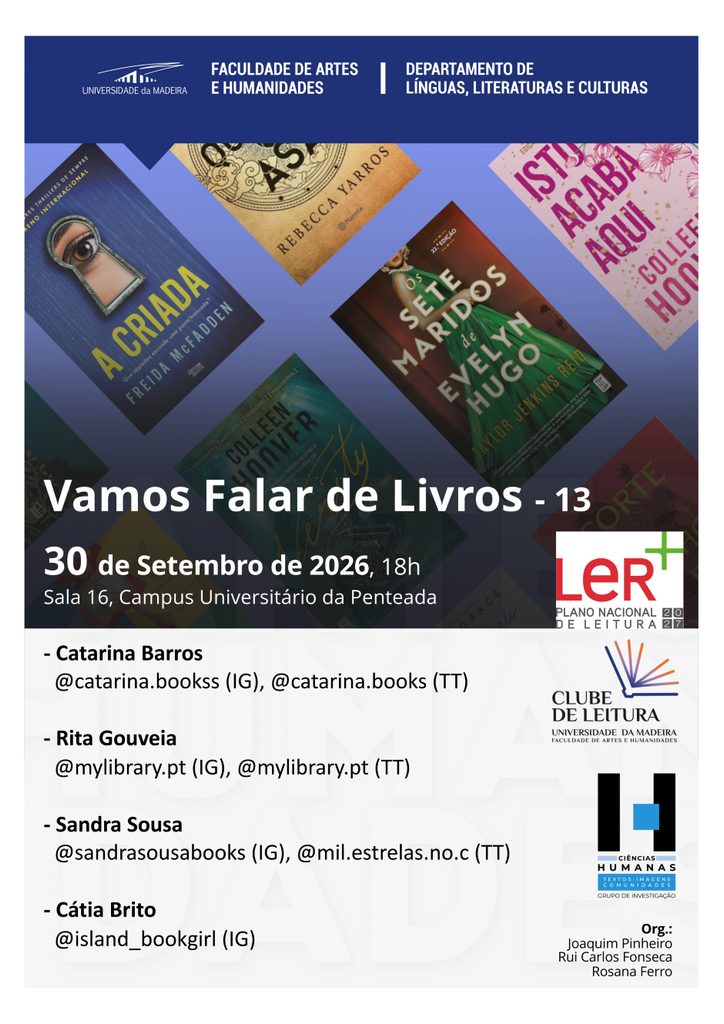
The 13th edition of ‘Let’s Talk About Books’ will take place on 30 September, from 6.00 pm, at the Penteada University Campus, and will be hosted by bookfluencers.
What are bookfluencers?
Bookfluencers are literary content creators who are active on one or more digital platforms, such as Instagram, TikTok or YouTube. Their main roles involve sharing their literary experiences, including their favourite and least favourite reads and their reviews, exploring and sharing new authors, discovering literary works and recommending books. Their posts use a more accessible style of discourse on literature, which, in turn, makes their recommendations feel more personal and credible. Bookfluencers greatly assist and enhance literary communication and promotion across digital media, which ultimately influences readers when they are deciding which literary works to choose and purchase.
24th and 25th September – International Philology and Medicine Seminar
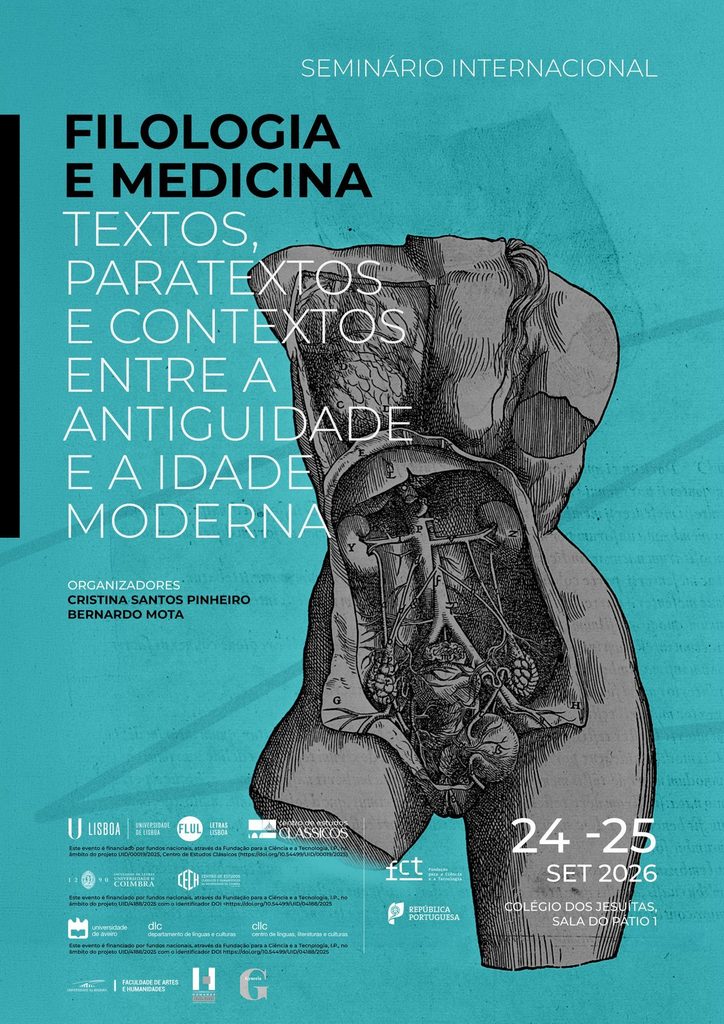
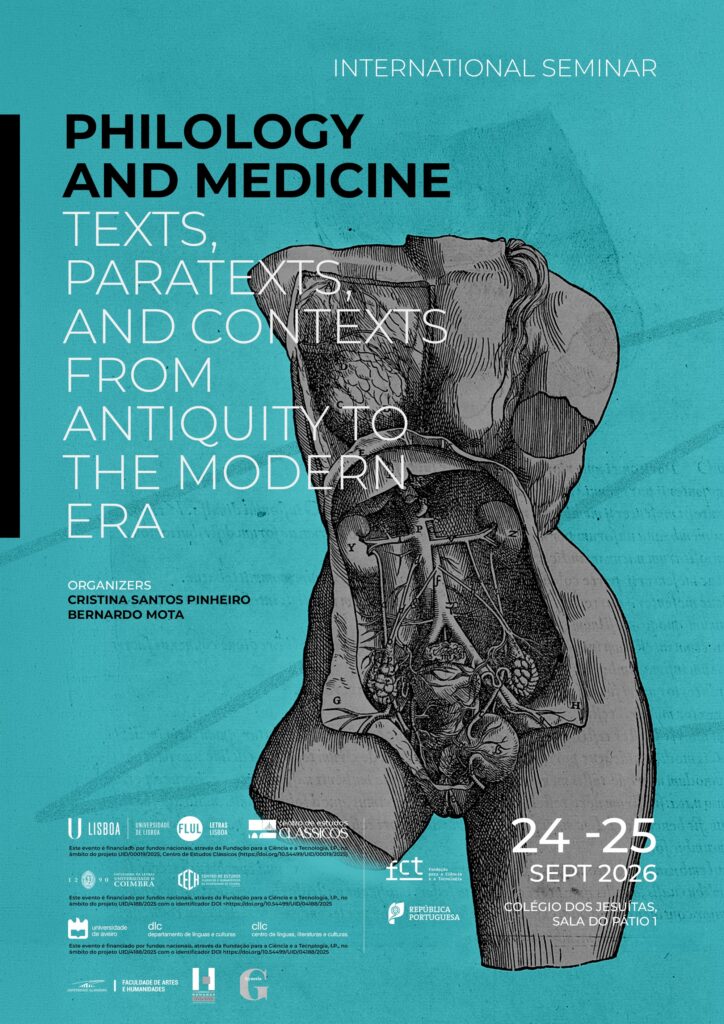
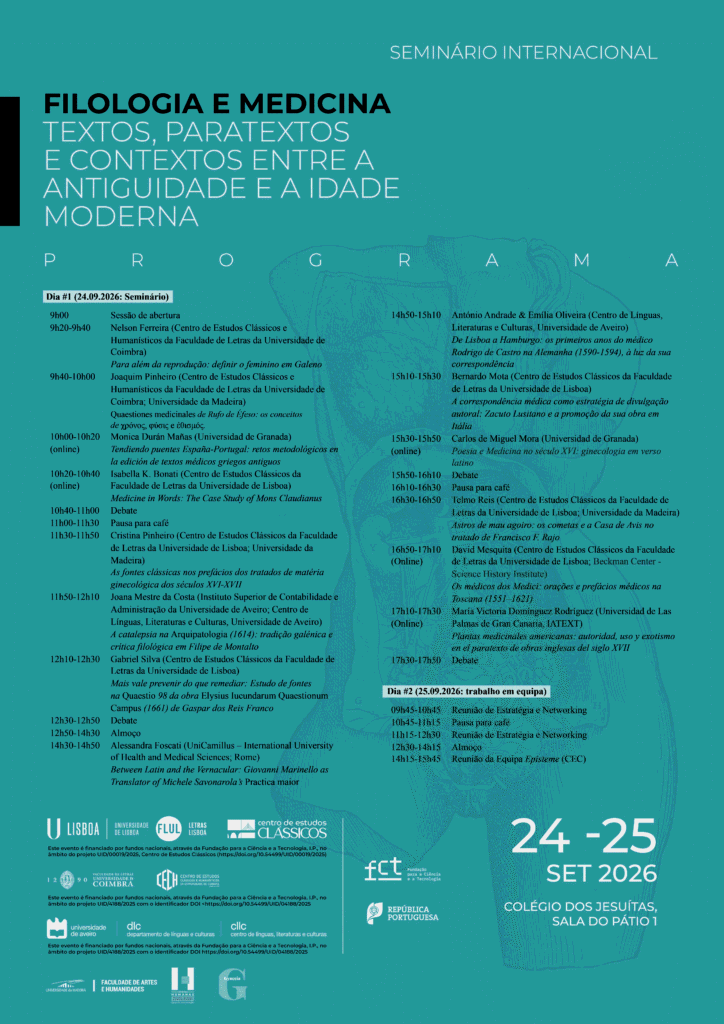
The International Seminar “Philology and Medicine: Texts, Paratexts and Contexts from Antiquity to the Early Modern Period”, organised by Cristina Pinheiro from the University of Madeira and Bernardo Mota from the University of Lisbon, will take place on the 24th and 25th of September 2026 at the Rectorate Building at the College of Jesuits.
Building on the Gynecia Project, the event brings together several scientific research units, namely the Centre for Classical Studies of the University of Lisbon, the Centre for Classical Studies and Humanities of the University of Coimbra, and the Centre for Literatures and Cultures of the University of Aveiro. It also includes the Humanities Research Group – Texts, Images and Communities of the University of Madeira.
The Seminar will bring together national and international speakers who, from a range of perspectives, will explore the intersection of philological studies with the history of medicine and science, covering the period from Classical Antiquity to the Early Modern Period. The program will include papers examining texts by authors such as Hippocrates, Rufus and Galen, extending from Classical Antiquity through the Middle Ages and into the Early Modern Period, including Michele Savonarola, Giovanni Marinello, Rodrigo de Castro, Filipe Montalto, Zacuto Lusitano and Gaspar dos reis Franco.
Admission is free.
13th July - The Many Voices of Plutarch
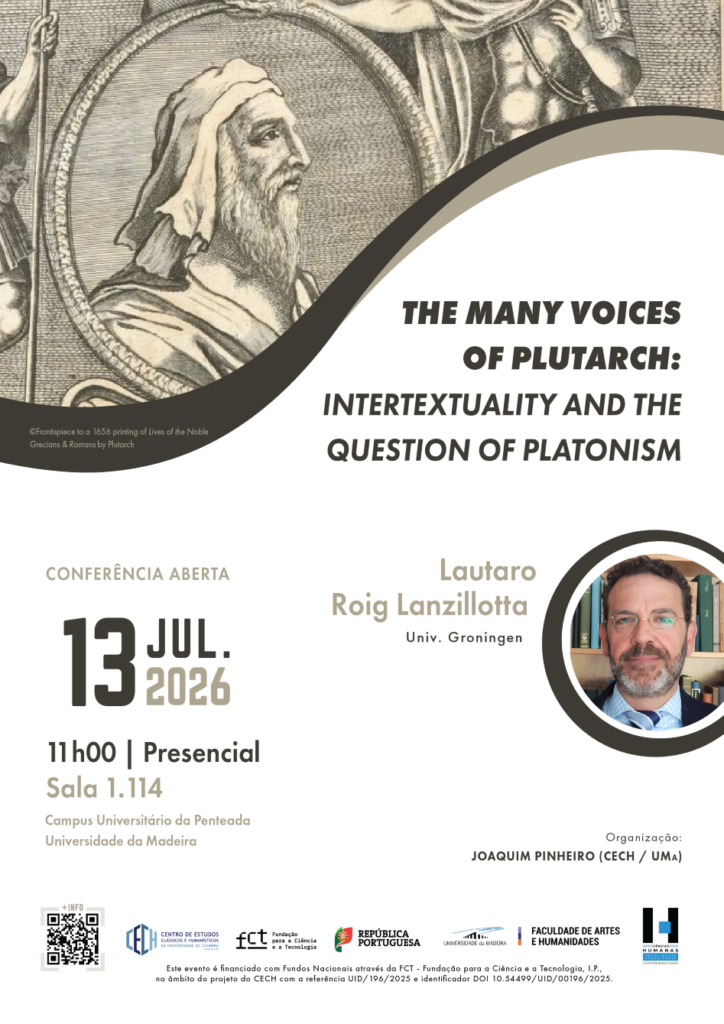
On the coming 13th of July, the open conference “The many voices of Plutarch: Intertextuality and the question of Platonism“.
The conference will take place in person in Room 1.114 at the Penteada University Campus, starting at 11:00, and will be delivered by Lautaro Roig Lanzillotta (University of Groningen).
AbstractThis paper reconsiders the long-standing characterisation of Plutarch of Chaeronea as a Platonist by approaching his works through the lens of intertextuality. Rather than treating Plutarch’s engagement with Plato as evidence of doctrinal adherence, I argue that his texts participate in a broader network of literary and philosophical references that complicates any straightforward attribution of philosophical identity. Drawing on theories of intertextuality, the paper examines how Plutarch appropriates, reconfigures, and juxtaposes Platonic material alongside to suit his own literary and philosophical agenda. Particular attention is paid to the ways in which quotation, allusion, and reinterpretation function as strategies of philosophical positioning rather than mere indicators of allegiance. Plutarch’s “Platonism” is better understood as a flexible and context-dependent construct, shaped through engagement with a plurality of sources. The question, therefore, is not simply whether Plutarch is a Platonist, but what it means to be a Platonist within an intertextual framework.
About Lautaro Roig Lanzillotta
Lautaro Roig Lanzillotta is Full Professor of New Testament and Early Christian Studies at the University of Groningen (the Netherlands). He is one of the most prestigious and recognised names in the international landscape of early Christian studies. He is director of the international consortium «Red Global», under which nine international universities offer the Erasmus Mundus master's degree entitled «Religious Diversity in a Globalized World». He holds a PhD in Classical Studies from the Complutense (1997) and a PhD in Theology from the University of Groningen (2004). His research focuses on the formation of Christianity in the first centuries of its existence, with a particular emphasis on the points of contact between Christianity and the Greco-Roman world. His publications lie in the field of apocryphal writing (especially in the genre of «apocryphal acts of the apostles» and apocalyptic literature). He is a renowned specialist in the Christian texts found in the mid-twentieth century in Nag Hammadi (Egypt) and in their Gnostic and philosophical aspects. In addition to being the author of numerous publications, Lautaro Roig Lanzillotta founded in 2016 the high-profile academic journal «Gnosis: Journal of Gnostic Studies» with the Dutch publishing house Brill. He is the principal editor of the «Nag Hammadi Bibliography Online»; and co-editor of the series (with Brill) «Plutarch Studies».